Cutting carbon emissions
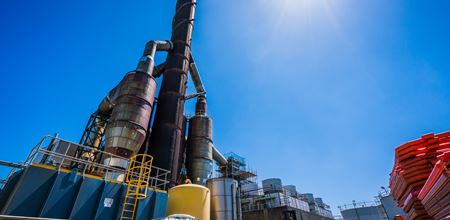
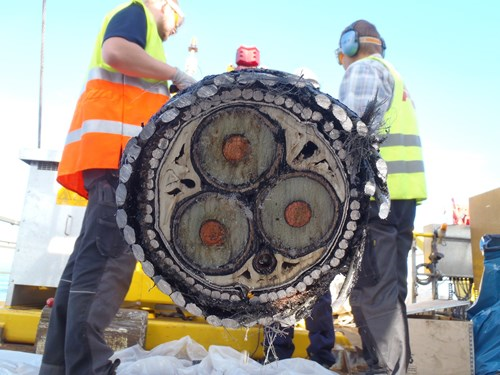
From GEL’s genesis, our energy source has changed drastically – from coal to oil, and now to renewables through our subsea importation cable (“GJ1”), which supplies around 90% of our total electricity.
The single biggest reduction to Guernsey’s carbon emissions was thanks to the installation of the importation cable GJ1 in 2000, finally giving us access to low-carbon electricity from the European grid. This relegated the power station to a ‘top-up and back-up’ source used when islanders demand more power during winter.
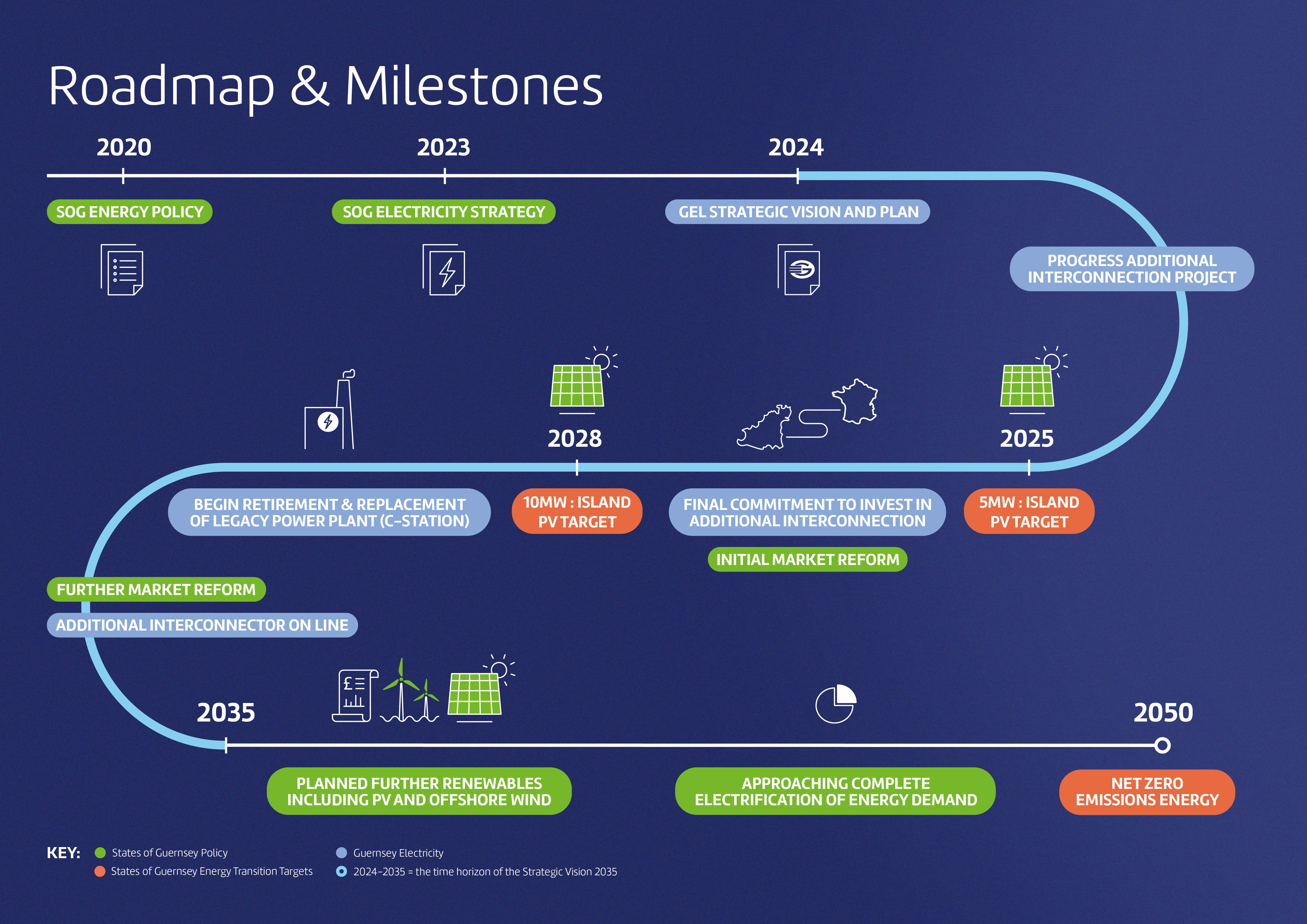
To power life beyond 2026, we must implement our roadmap of actions to upgrade our infrastructure by 2050, in line with the States’ Electricity Strategy.
Rigorous research, assessments and considerations explored several ways Guernsey could meet its future demand; tidal, solar, wind, alternative fuels, or additional interconnectors.
After careful consideration, UK experts recommended that the States of Guernsey establish:
- Additional ‘interconnection’ (through a second subsea importation cable)
- On-island renewables (solar PV), and;
- Offshore renewables
For decades, the energy industry had its unofficial colour spokesperson: orange. The fiery power of fossil fuels, rippling heat of power stations, glowing embers of a sulphur-tinted sunset. But Guernsey is no longer fully coloured by that shade of the past. Our vision for the upcoming decades is powered by low-carbon sources delivered through our imported supply and renewables. A future that is unequivocally, green.
2025 was no ordinary year for us as it marked 125 years for Guernsey Electricity (GEL). More than other years, we’ve had reason to reflect and appreciate our evolution; from the first production and distribution of electricity in February 1900, all the way to powering artificial intelligence today.
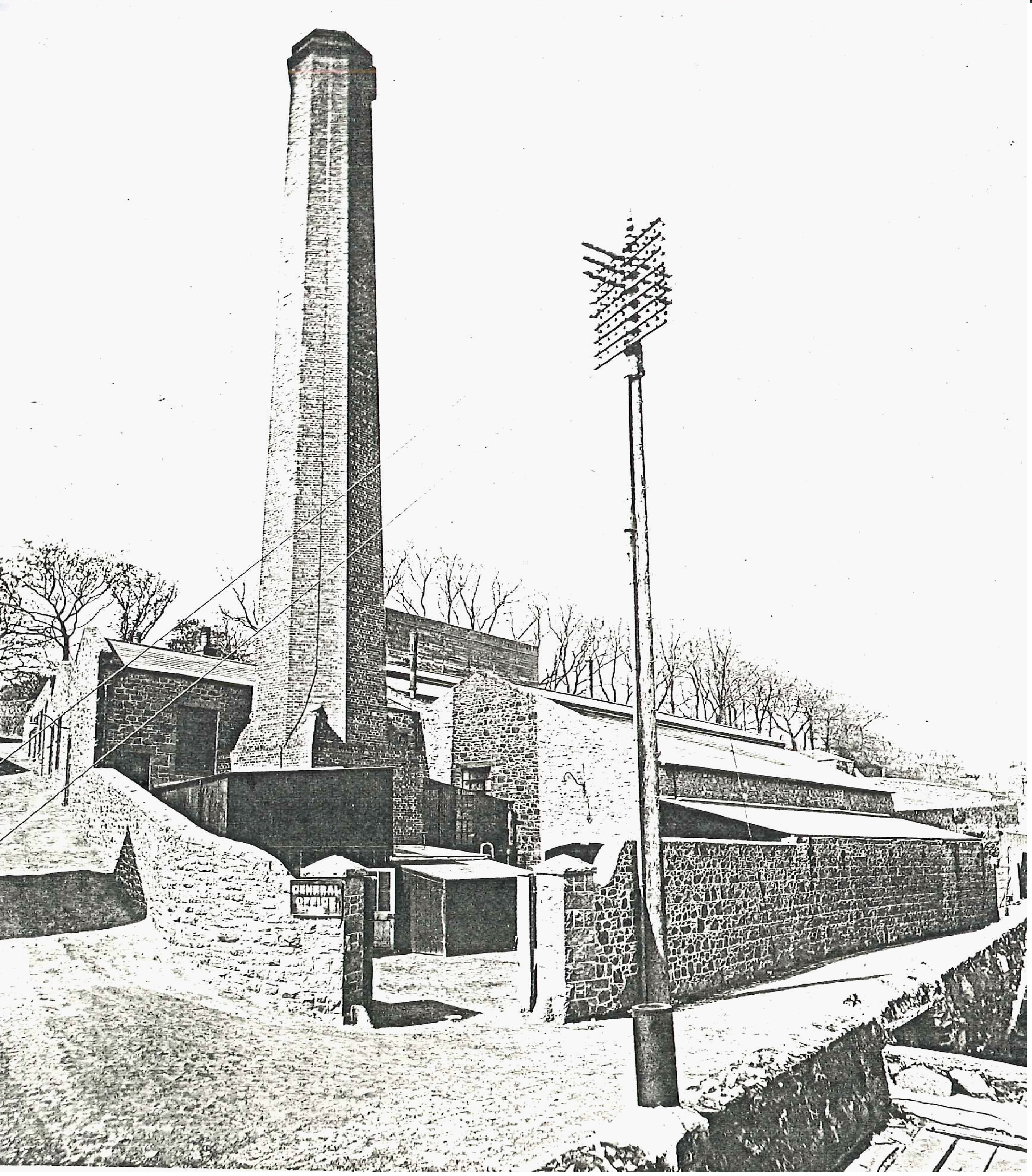
But we’re not here to write about our past.
Celebrating 125 years further energised us (pun intended) for the future. To 2026 and beyond, said with a Buzz Lightyear inflection, perfectly summarises our direction.
These aren’t generic end-of-year words. But we have written a fair few words in our Strategic Vision 2035, which details the island’s future energy needs and how to deliver them.
But first, we must quantify what we mean by ‘anticipated energy demand’, so we’ll run through some numbers.
Energy demand predictions
‘Peak demand’ is a point in the day when everybody uses electricity at the same time, usually around breakfast, lunch and dinner. This means it’s more expensive to supply at these times as we need to use more resources and place more pressure on the grid.
Siemens estimates that peak demand for electricity in Guernsey could reach around 157 megawatts (MW) by 2050, almost a 70% increase on the highest peak scaled at 94MW in January 2024.
This anticipated rise reflects the fast adoption of electric transport and heating, paired with a projected rise in our island’s population.
Guernsey’s energy future is not comparable to the rest of the world. Unlike most electricity providers, here in Guernsey we’re responsible for every stage of the journey, including generating, importing, and distributing electricity to homes and workplaces. This means we need a holistic approach that crosses all borders of the business to manage how power reaches you, in tandem with the rapidly evolving world.
What is the energy transition?
We’re moving away from our reliance on fossil fuels, to a life powered by low-carbon, sustainable energy.
To make this shift, Guernsey is strategically building out a diverse supply, anchored by our current subsea cable, expanded on-island renewables, and the planned introduction of a second subsea link.
So when you read about the energy transition, it’ll hopefully not be an ambiguous term with little meaning to you.
Plus, if ‘decarbonisation’ sounds abstract, it can be defined as the process of reducing or removing carbon dioxide (CO2) emissions from economic activity to mitigate the effects of anthropogenic (manmade) global warming.
For us here at Guernsey Electricity, that means increasing islanders’ access to low-carbon energy sources such as hydro, wind and solar, and encouraging better energy efficiency.
And now comes the implementation of that infrastructure – decarbonisation through the energy transition. Aren’t you glad we clarified those terms?
The future isn’t tomorrow – the deadline is today
Do you ever catch yourself asking where the year has gone? Isn’t time moving faster every year?
There’s no time to waste in making sure Guernsey is equipped to power lives today, tomorrow, and long into the future.
At this contemplative time of year, you may wonder what the future of our power supply looks like.
- Electricity will continue to be decarbonised by enhancing supply chains.
- In 2035 the supply of electricity will still be predominantly imported through cable interconnection to Europe, potentially through two cables.
- We’ll also use more energy from local renewable resources – mostly solar.
The future will inevitably play the uncertainty card, but when it comes to Guernsey’s energy strategy, we won’t leave anything to chance. Our role is to consistently stack the deck in islanders’ favour, anticipating the next hand so we can continue to provide reliable, sustainable energy that powers life today and tomorrow.