Green finance has been the talk of the town in recent years, and for very good reason. But how can your workplace bypass buzzwords and actually cut carbon emissions to attract those clients seeking out sustainable business partners?
When it comes to electricity, we think we can help.
Who gets Christmas day off?
Which day of the year do you think we use most electricity in Guernsey?
Perhaps when everyone is at home, the heating is on, the ovens are working overtime, and the lights might stay on pretty much all night.
Answer – it isn’t Christmas day. And there’s a very good reason for that.
Many people are off work over Christmas. And that means our weekday electricity consumption often…drops.
But why is that? The reality is local business is the primary driver behind energy peaks.
Office politics
This isn’t just all those big offices we see lighting up Admiral Park at night (although turning them off would be fantastic).
It’s the constant buzz of business-scale water heating, central heating systems, aircon and data servers working up a sweat all day, every (week) day.
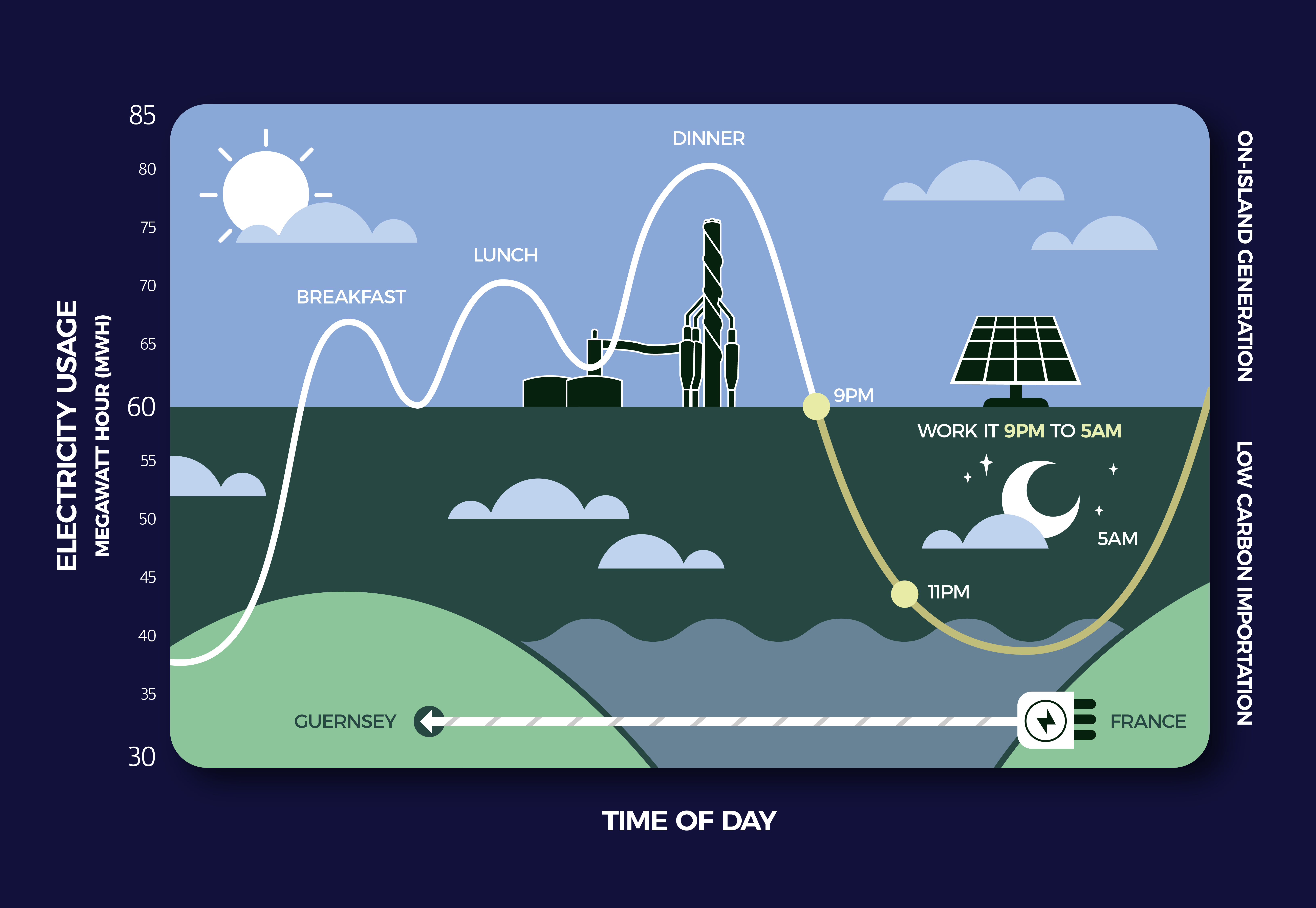
Then when people head home in the late afternoon, the idling hardware, heating and lighting is still at work - at the same time as we get home and pop on the lights, dial up the heating, flick consoles off standby, make some hot drinks, clean up in the sink, and get the dinner started from around 5pm to 8pm.
In Guernsey, winter weekdays are busier than Christmas.
Isn’t using electricity better for the environment?
Using too much electricity isn’t quite as innocent as it may seem at first.
It may feel cleaner than using gas, oil, coal and wood. But between October and March, if islander's demand more than the 60MW (Megawatt) capacity the subsea cable can import, we also need to burn tonnes of fossil-fuels at the Vale Power Station to keep up.
What’s the issue?
Here’s a fact you probably didn’t know islanders all have to face.
Our current ‘maximum demand’ was 94MW, hit in January 2024. The anticipated maximum demand for electricity is forecast to rise to 157MW by 2050.
But isn’t that someone else’s problem to deal with?
Well, we’re challenged to work alongside the community to help save over £100 million by reducing this predicted demand to 125MW.
This spend factors in extra network investment which includes:
- installing larger underground cables
- adding more substations
- upgrading grid equipment
This is all needed to make sure we can handle the highest demand on the coldest, darkest winter’s night.
In plain English, that means we’ve got a choice. All use less power at peak times, or spend a fortune on the electricity grid.
Over £100 million is a staggering amount of money that won’t need to be passed down to islanders in future price rises if we (particularly businesses) can move more electricity use off-peak.
Put another way, soon there will be too many 'cars' (electricity demand) for the current motorway lanes (network). Either we spend over £100 million building more lanes, or we can work together to spread out the traffic.
What can my workplace do?
Would your business consider a Property Energy Management Strategy if it hasn’t already? This could be a positive way to help reduce your workplace carbon footprint.
Cutting down electricity waste is key - but so is moving it off-peak.
The best time to use electricity in Guernsey is between 11pm and 5am, as it’s cheaper* and we can rely 100% on low-carbon electricity imported from the European grid. But that isn’t always practical. And unless you’re a night owl, hopefully you’re often not still at the office at this hour either.
The second-best time is between 10am and 4pm. That’s because the grid is a bit quieter during those times, so there are some dips in demand.
GE2B Energy Action List
- Company electric vehicles: Set them to charge between 10am and 4pm if you can’t charge them between 11pm and 5am
- Insulation: If your building is more than ten years old, consider investing in property insulation – heat loss is one of the biggest contributors to big bills and wasted energy, no matter how you heat (electric, oil or gas).
- Central heating and air conditioning (HVAC): Set these systems to start later and finish earlier, even half an hour makes a big difference
- Water heating: Set timers to heat between 11pm and 5am. To make sure you don’t run into any legionella issues, set timers to heat it again during your business cheap times between 10am and 4pm. No timers yet? These can be installed by an electrician.
- Onsite data processing: See if non-essential processing can be done overnight, ideally between 11pm and 5am
- Solar panels: Make sure these are designed only for your business needs. Also consider battery storage, as you’ll save more money by offsetting the unit cost of normal rate electricity than by selling that unit back to the grid at the Buy Back tariff rate.
The main takeaway
#TLDR
Businesses and workplaces demand a huge amount of electricity. And it’s not just up to us at home to try and help cut local carbon emissions and future electricity tariffs.
Cutting electricity use or moving off-peak has important ripple effects which you should be able to see in your environmental reporting.
- Best time: 11pm to 5am
- Second best time: 10am to 4pm
Need a one-to-one?
We’re offering our GE2B drop-in sessions to businesses who are keen to reduce their electricity use and understand what practical things they can do to make this happen.
If you’d like one of our team to pop in and talk to your environmental group, facilities manager, sustainability manager, founder or CEO (or maybe all the above), let us know.