Most business leaders assume AI-generated prose is easy to spot. They'll look out for the telltale signs such as overreliance on lexical inflation like ‘delve into’, or ‘testament to’, or breathless clichés like ‘in today’s fast-paced digital landscape.’
These may even trigger subconscious voices that whisper ‘now there’s an AIism if ever I saw one’. Or perhaps they groan at painfully long social media posts stuffed with emoji bullet points and rule-of-three descriptions varnished with that unnerving eagerness to please.
(Quiz question – how do you type an em dash on a smartphone or laptop again..?)
This brings us neatly to our confession; sections of this piece were drafted by a Large Language Model (LLM). Others were also brainstormed, typed out, redrafted, edited, fretted over, deleted, word-counted, and retyped by human hand, working alongside AI for ideation (and sometimes moral support). Can you spot which is which?
But while we’re busy trying to checkmate AI users and deduce what’s real, we rarely stop to consider the more burning question.
WHAT DOES IT COST TO REPLICATE HUMAN WORK?
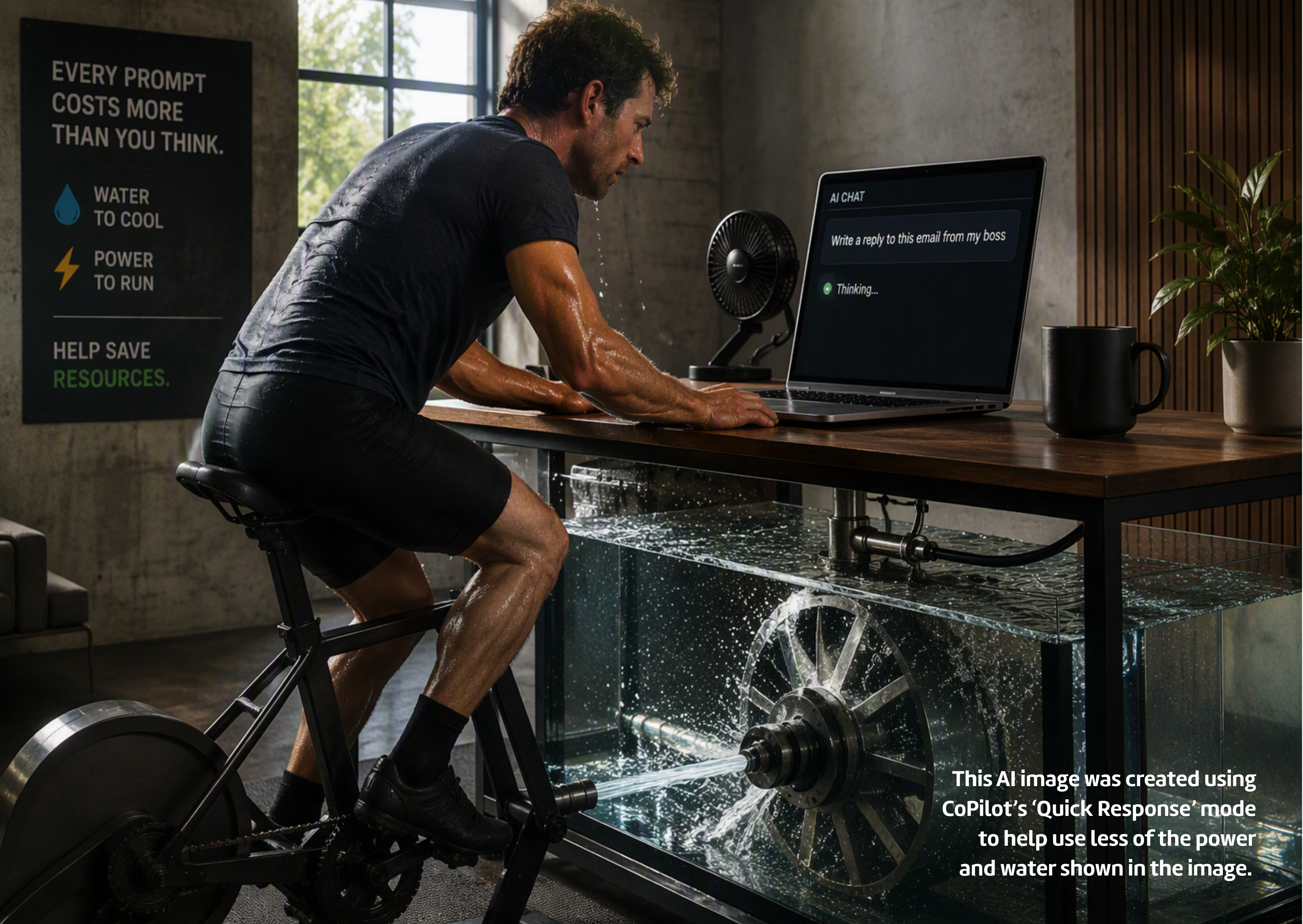
You’ve probably mentioned the word ‘cloud’ more in the last 15 years than previous generations did in a lifetime. Thanks to this moniker, we frame our digital habits through a weightless metaphor which feels virtually cost-free. We picture data floating harmlessly overhead, yet reality is grounded in massive, heavy, energy-guzzling data centres. Driven by heavy-duty processors, these centres are thirsty for gallons of water as they generate relentless heat and eat up massive amounts of electricity.
‘Driven by heavy-duty processors, these centres are thirsty for gallons of water as they generate relentless heat and eat up massive amounts of electricity’
Let us delve into the profound intersection of two distinct resources without which modern AI could not exist — a dynamic pairing widely considered to be mutually exclusive.
Electricity: Today’s fast-paced digital demand means training a single frontier model requires thousands of megawatt-hours, akin to powering hundreds of homes every year. However, true enterprise challenges lie in inference –– the millions of small, daily prompts driving real-time decision-making. Furthermore, executing a single LLM query demands significantly more power than traditional search –– underscoring a critical, complex and costly paradigm shift.
Water: Data centres rely heavily on evaporative cooling –– a vital mechanism designed to safeguard infrastructure, maintain stability, and prevent servers overheating. Consequently, every generated mock-up or rewritten email exerts hidden pressure on water supplies –– a stark testament to the environmental trade-offs of artificial intelligence. An extended exchange of 20 to 50 prompts could consume around 500 millilitres of water to cool data centre servers –– transforming a simple carbon footprint into a pivotal, profound and far-reaching hydrological concern.
DIGITAL GOLD DUST
Now we understand the trade-offs a little better, it doesn’t mean we have to boycott automation. It’s best to treat ‘compute power’ like any other finite resource - and recognise that AI processing is, at times, like pure gold dust.
Here are some actions organisations can take to cut wasted processing and use AI more responsibly. But were they pasted straight from ChatGPT, or polished by a real writer?
Pick the right tool for the job.
Need to fix your grammar or help write a short email? You don’t need to use a massive, ultra-smart AI model for that. Toggle to the smaller, lightweight version for those simple, day-to-day tasks, as this uses a fraction of the same electricity and water. Head to a search engine and type in your preferred AI model followed up with ‘lightweight’, ‘flash’, ‘mini’, or ‘haiku’ to find out how to access the smaller sidekick.
A problem shared is a resource halved.
If 20 employees all ask AI for the same company policy, that’s 20 separate compute cycles burning through power and water. Ask your workplace to set up simple systems to save and reuse common answers so AI only has to do the heavy lifting once.
Swipe left on pointless visual gimmicks.
Yes, they’re funny. Fascinating. Horrifying at times. But generating a ‘quick’ AI image or video uses a criminal number of resources compared to generating text – imagine charging your phone dozens of times for just one photo. If you know you don’t really need it, could you just skip it? If you need photos or graphics for e.g. a presentation, try searching ‘free stock images’ for some really good imagery.
Polish then prompt.
Vague requests like ‘write me a report (please)’ can lead to five or six back-and-forth edits to get to where you really want. Just as you’d give a human worker a precise brief to save billable hours, give AI a clear request upfront to stop it from running expensive processing cycles over and over. Already know what you want? Ask for it in the clearest way possible.
GOING AI-LITE
Did you spot which paragraphs were written by a robot?
Either way, this piece of deduction matters less than the broader picture. Every word, image, video, or sepia-toned event poster crammed with AI-generated marketing clichés leaves a print.
The fuel driving the AI boom isn’t limitless. Behind every moving school photo, deepfake video and AI-generated marketing campaign sits a vast web of infrastructure to generate, store, distribute and cool the energy that powers it all.
By choosing lighter model options for small tasks, sharing common answers across teams, ditching pointless image or video generation, and prompting with precision, we can help keep the magic of AI alive while asking a little less of our finite water and energy supplies to power each prompt.